
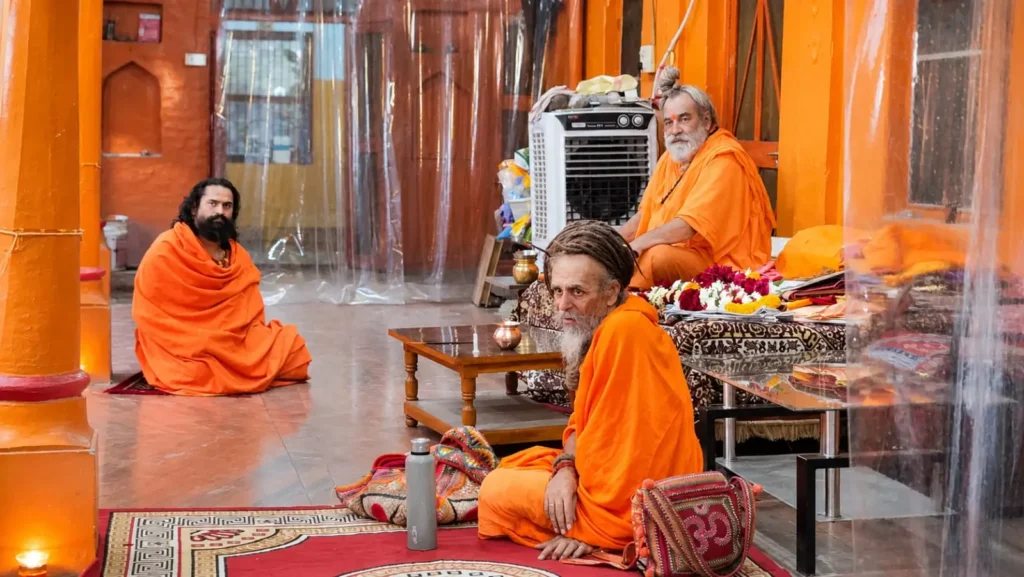
(Yogi Priyavrat Animesh reveals the profound relationship between celestial knowledge, human consciousness, yogic wisdom, intellectual discernment and the spiritual awakening of inner perception.)
New Delhi, India | November 26, 2026
The Wisdom of Time, the Eye of Intelligence and the Purity of Knowledge
A Spiritual and Yogic Discourse by Yogi Priyavrat Animesh
O seekers of wisdom! What is that invisible principle within this infinite universe through which the entire creation undergoes continuous transformation? What governs the rising and setting of the Sun, the changing phases of the Moon, the succession of seasons, the germination of seeds, the flowering of trees, the birth of living beings, their passage from childhood to youth and from youth to old age, and ultimately the dissolution of their physical existence? That fundamental principle is known in the Indian philosophical tradition as Kāla (Time).
Time itself cannot be perceived through the physical eyes, yet its presence becomes evident through every transformation occurring within existence. A clock measures intervals of time, the movement of the Sun indicates the progression of the day, and the changing phases of the Moon provide the basis for lunar calculations. Nevertheless, these are merely indicators through which we understand time; they are not time itself. Just as the wind remains invisible while its presence is revealed through the movement of trees, time reveals itself through the transformation of existence. It is the systematic investigation of this temporal order, celestial movements, recurring cycles and their relationship with the changing conditions of existence that constitutes a fundamental dimension of the ancient Indian discipline known as Jyotisha.
When the ancient tradition describes Jyotisha as knowledge of the highest excellence, one must first understand the deeper meaning of excellence, knowledge and illumination. Excellence signifies the highest refinement of a particular faculty. Knowledge is not merely the accumulation of information; it is the ability to understand the nature of something, its underlying causes, its relationships, its surrounding circumstances and its possible consequences. The Sanskrit term Jyotisha is derived from Jyotis, meaning light or illumination. The essential nature of light is that it reveals what darkness previously concealed. Light does not create the object that it illuminates; it simply makes the object visible.
Imagine a traveller walking along an unfamiliar road in the darkness of night. Without a lamp, the traveller may be unable to distinguish a stone from a clear path, a shallow depression from a dangerous obstacle, or the correct direction from an uncertain passage. When a lamp is lit, the road itself does not change. The obstacles remain where they were, and the traveller must still undertake the journey through personal effort. What changes is the traveller's ability to perceive the surrounding conditions and navigate them with greater awareness. In its noblest philosophical conception, Jyotisha serves a similar purpose. It is intended not to replace human action, but to illuminate our understanding of time and circumstances. Knowledge may reveal the path, but the responsibility of walking that path always remains with the individual.
The ancient seers of the Vedic tradition envisioned the Vedas not merely as sacred texts but as an integrated living body of knowledge, symbolically described as the Vedic Cosmic Being. Just as every organ of the human body performs a distinct function while contributing to the well-being of the whole, the Vedic tradition recognizes six complementary disciplines known as the Vedāṅgas, or limbs of Vedic knowledge. Śikṣā, the discipline of pronunciation and phonetics, is compared to the nose; Vyākaraṇa, the science of grammar, to the mouth; Nirukta, the investigation of the origins and meanings of words, to the ears; Kalpa, the discipline governing ritual procedures, to the hands; Chandas, the science of poetic and sacred metre, to the feet; and Jyotisha, the discipline concerned with celestial observation and the determination of time, to the eyes.
Each of these disciplines possesses its own importance. Śikṣā preserves the accuracy of sacred pronunciation; Vyākaraṇa maintains the structure and precision of language; Nirukta investigates the deeper meanings concealed within words; Kalpa establishes the proper methods of performing prescribed actions; Chandas preserves the rhythmic organization of sacred expressions; and Jyotisha determines the temporal framework within which particular Vedic activities are undertaken. The reason Jyotisha is regarded as the eyes of this integrated body of knowledge is profound. Understanding how an action should be performed is not always sufficient; understanding when it should be performed is equally significant.
Consider a farmer who possesses excellent seeds, fertile soil, abundant water, appropriate agricultural equipment and complete knowledge of cultivation. Yet if the farmer sows those seeds without considering the appropriate season, will the possession of all these resources necessarily guarantee a successful harvest? The seed carries the potential to become a plant. The soil possesses the capacity to support its growth. Water provides nourishment, and the farmer contributes intelligence and labour. Nevertheless, the realization of that potential depends upon the convergence of favourable conditions.
In this example, the seed represents knowledge, the soil represents the field of action, water represents available resources, the farmer's labour represents human effort, and the recognition of the appropriate season represents the wisdom of time. This is why the Vedic tradition did not concern itself exclusively with the procedures of sacred actions but also established methods for determining the appropriate times for rituals, sacrifices, festivals and religious observances.
The Vedāṅga Jyotiṣa expresses this principle through the following declaration:
Tasmād idaṃ kālavidhānaśāstraṃ yo jyotiṣaṃ veda sa veda yajñān.
This means that Jyotisha is a discipline concerned with the determination and organization of time, and that understanding it enables one to understand the temporal requirements of Vedic sacrificial practices. The deeper implication is that possessing the ability to perform an action and possessing the wisdom to recognize its appropriate timing are two distinct yet complementary forms of intelligence.
When the traditional expression compares a person unfamiliar with Jyotisha to someone without physical sight, it must be understood as a philosophical metaphor rather than a judgment upon physical ability. A person without physical eyesight may possess extraordinary intelligence, wisdom, insight and spiritual understanding. The comparison concerns the importance of orientation. Just as physical vision helps an individual recognize the visible path, informed awareness helps the mind navigate changing circumstances. The absence of understanding can leave an individual uncertain about the direction in which available abilities and resources should be employed.
A person may possess immense wealth, yet without the wisdom to use it appropriately, that very wealth may become a source of suffering. Another may possess extraordinary eloquence, yet without understanding when to speak, when to remain silent, which words are appropriate under particular circumstances and what consequences those words might produce, the gift of eloquence itself may become destructive. Fire possesses the capacity to prepare nourishment, but the same fire can also destroy a home. The fundamental difference lies not in the existence of fire, but in the circumstances of its application and the understanding of the person employing it. Therefore, the acquisition of power, intelligence or resources is incomplete without the wisdom to direct them.
O seekers! Human beings possess different dimensions of perception. The first is physical vision, through which the material world becomes visible. The second is intellectual vision, through which the mind investigates the causes and relationships underlying what has been perceived. The third is discerning wisdom, through which understanding is transformed into appropriate judgment and action.
When dark clouds gather in the sky, the physical eyes recognize their presence. Intellectual understanding examines atmospheric conditions and recognizes the possibility of rainfall. Discernment then determines what preparations should be made in anticipation of that possibility. The perception of an event, the investigation of its meaning and the application of that understanding represent three progressively refined dimensions of knowledge.
It is this higher faculty of discerning intelligence that the Indian tradition describes as Prajñānetra (The Eye of Wisdom). The Sanskrit word Prajñā signifies profound understanding, refined intelligence and discernment, while Netra means the instrument of vision. Prajñānetra, therefore, is not merely the capacity to observe what is immediately visible. It is the cultivated ability to investigate underlying causes, recognize relationships, evaluate possibilities and respond to circumstances with wisdom. It is not necessarily a reference to a third physical eye hidden somewhere within the human body. In this context, it represents a higher development of the inner faculty of understanding.
Within the philosophy of Yoga, this principle acquires an even more subtle meaning. The physical senses receive impressions from the external world; the mind directs its attention towards those impressions; the deeper mental field brings forth accumulated memories and impressions; the intellect evaluates the experience; and the ego associates that experience with one's individual identity. Consequently, human perception is influenced not only by external reality but also by the internal condition of the observer.
When the mind is dominated by fear, an ordinary circumstance may appear threatening. When attachment governs the intellect, an obvious defect may appear to be a desirable quality. The external reality of an object and the internal interpretation constructed around it are not always identical.
Observe the reflection of the Moon upon a lake. When the water is clear and undisturbed, the reflection appears distinct. When the surface becomes turbulent, the same Moon appears fragmented. When the water becomes clouded, its reflection becomes obscure. The Moon itself has undergone no corresponding transformation. The disturbance exists within the medium through which it is being perceived. Similarly, reality may remain unchanged while the human experience of it varies according to the condition of the mind.
Maharshi Patañjali defines Yoga as the stilling of the fluctuations of the mind. As the disturbances within the mental field gradually diminish, the practitioner becomes better able to distinguish actual circumstances from personal fears, desires, memories and assumptions. The awakening of wisdom does not occur merely through the accumulation of books or information. It also requires disciplined study, observation, contemplation, experience, concentration, self-examination and the refinement of the inner faculties.
In the Bhagavad Gita, Sri Krishna describes a higher quality of intelligence as Sāttvika Buddhi, or lucid and balanced discernment. Such intelligence recognizes the distinction between engagement and withdrawal, duty and misconduct, legitimate fear and fearlessness, bondage and liberation. The cultivation of this faculty enables an individual to examine circumstances beyond the limitations of personal preferences and preconceived beliefs.
It is for this reason that the traditional invocation declares:
"For the awakening of the Eye of Wisdom, I invoke Vāgdevī."
The Sanskrit expression Unmīlita signifies an opening, an awakening or the unfolding of something previously concealed. Consider a flower whose entire potential remains enclosed within a bud. Under appropriate conditions, the bud gradually opens and reveals a beauty that was already inherent within it. Human intelligence possesses a comparable potential. Education, contemplation, disciplined practice, curiosity and experience provide the conditions through which that potential may unfold.
The seeker who invokes the awakening of wisdom does not proclaim that all knowledge has already been attained. On the contrary, such an invocation begins with the recognition of one's own incompleteness. Genuine scholarship begins when an individual acknowledges that the knowledge already acquired represents only a limited portion of what remains to be understood.
Vāgdevī is a sacred name associated with Goddess Saraswati, revered in the Indian spiritual tradition as the embodiment of knowledge, learning, language, memory, intellectual refinement and creative expression. The Sanskrit word Vāk signifies speech, but its philosophical meaning extends beyond audible words. It represents the faculty through which an inner thought acquires an intelligible form and becomes capable of being communicated to another consciousness.
Her invocation possesses particular significance in the study of Jyotisha. A practitioner must understand mathematical calculations, observe celestial conditions, interpret ancient texts, examine different principles, evaluate conclusions and ultimately communicate those conclusions through language. An error at any one of these stages can influence the integrity of the final interpretation.
A calculation may be mathematically accurate, yet its interpretation may be mistaken. An interpretation may be reasonable, yet its communication may be irresponsible. When an uncertain possibility is presented to another person as an unavoidable future event, those words can generate anxiety and fear, influencing that individual's behaviour, judgment and confidence. A statement concerning the future may even alter a person's present conduct through the psychological expectations it creates.
The responsibility of a person who communicates knowledge is therefore considerable. Words do not merely transfer information; they can also influence the emotional and psychological world of another human being. The deeper significance of invoking Goddess Saraswati lies in seeking not only intellectual brilliance but also clarity, precision, compassion, restraint and responsibility in expression. The purpose of speech should never be to frighten another person into submission. Its higher purpose is to cultivate understanding, strengthen discernment and communicate truth without exceeding the limits of one's knowledge.
Yet the awakening of intelligence alone does not constitute the completion of spiritual discipline. The traditional invocation continues:
"For the Eye of Wisdom to remain free from distortion, I meditate upon Vighneśvara."
The Sanskrit word Avikṛta possesses extraordinary philosophical significance. Vikṛta describes something that has become altered, distorted or separated from its authentic condition. Avikṛta signifies that which remains undistorted and faithful to its original nature. The invocation therefore distinguishes between two separate achievements: the awakening of knowledge and the preservation of its integrity.
Imagine a perfectly clear mirror reflecting an object placed before it. If the surface of that mirror becomes distorted, the same object may appear unnaturally enlarged, diminished, bent or fragmented. The object has not changed; the instrument through which it is being perceived has become unreliable.
The human intellect functions in a comparable manner. Knowledge may be present, yet if the faculties interpreting that knowledge become influenced by ego, greed, attachment, fear, anger or prejudice, the resulting judgment may depart significantly from reality.
Ego persuades individuals that their conclusions cannot be mistaken. Greed transforms knowledge into an instrument of personal advantage. Attachment encourages interpretations that satisfy personal desires. Fear magnifies ordinary uncertainties into apparent dangers. Anger weakens impartial judgment. Prejudice encourages the acceptance of information that supports existing beliefs while rejecting information that challenges them. Excessive confidence transforms possibilities into declarations of certainty, while uncontrolled imagination produces conclusions unsupported by sufficient evidence.
Modern psychology recognizes many of these tendencies as cognitive biases. The yogic tradition investigates similar human limitations through the concepts of mental fluctuations, accumulated impressions and psychological afflictions known as Kleśas. Although their explanatory frameworks are different, both invite attention to an important problem: the reliability of human judgment depends not only upon the information available but also upon the condition of the mind interpreting it.
Suppose a practitioner of Jyotisha develops a predetermined belief that a particular event must occur in someone's life. If every celestial configuration, every personal circumstance and every subsequent observation is interpreted exclusively to support that predetermined conclusion, the practitioner is no longer investigating whether the belief is true. The practitioner is searching for confirmation of an existing conviction.
Likewise, if a person makes a hundred predictions, remembers only the few that happen to correspond with actual events and disregards those that fail, personal confidence may increase without any corresponding improvement in the reliability of that knowledge. Intellectual integrity requires the willingness to examine unsuccessful conclusions as carefully as successful ones, acknowledge mistakes, investigate contradictory evidence and revise established beliefs when necessary. Otherwise, the illusion of knowledge may become more powerful than knowledge itself.
This is where the deeper meaning of Vighneśvara becomes evident. Vighna means an obstacle, and Īśvara signifies a lord or governing principle. Vighneśvara is a sacred name of Lord Ganesha, revered as the remover of obstacles and the embodiment of intelligence and discernment.
However, the obstacles confronting a spiritual seeker do not arise exclusively from external circumstances. The ego within the mind is an obstacle. The desire to display one's intellectual superiority is an obstacle. The temptation to gain recognition through exaggerated claims is an obstacle. The inability to acknowledge an error even when confronted with sufficient evidence is also an obstacle. External opposition can often be recognized relatively easily, but identifying ignorance concealed within one's own intelligence is considerably more difficult, because ignorance frequently presents itself wearing the appearance of knowledge.
The meditation upon Lord Ganesha therefore carries a profound inner significance. The seeker invokes the removal of those psychological and intellectual impediments that prevent the mind from perceiving reality with clarity. It is a prayer that intelligence should never become enslaved by pride, that learning should never become corrupted by selfishness, and that conviction should never become more important than truth.
There is also a subtle distinction between remembering Goddess Saraswati and meditating upon Lord Ganesha. Remembrance brings a principle into conscious awareness, while meditation involves sustained attention and the gradual stabilization of the mind upon that principle. Through the remembrance of Saraswati, the seeker awakens an aspiration towards knowledge, inquiry, linguistic precision and intellectual excellence. Through meditation upon Ganesha, the seeker cultivates steadiness, discernment and the removal of inner distortions.
One invocation concerns the opening of the doors of intelligence; the other concerns the preservation of what enters through those doors. Just as opening the entrance of a house does not eliminate the responsibility of determining what should be allowed inside, expanding the boundaries of knowledge does not eliminate the necessity of intellectual discipline. The growth of intelligence and the refinement of intelligence are complementary dimensions of spiritual development.
Having understood this, consider the nature of time itself, through which the broader tradition of Jyotisha developed. Human consciousness ordinarily experiences time through three dimensions: the past, the present and the future. The past leaves behind consequences, memories, accumulated experiences and psychological impressions. The present is the condition in which the individual experiences those consequences while simultaneously initiating new actions. The future represents the possibilities emerging from present circumstances, human decisions and countless known and unknown influences.
By observing the present flow of a river, one may investigate its geographical origin, the rainfall that nourishes it and the structure of the land through which it travels. One may also estimate the direction in which it is likely to continue. However, without complete knowledge of future rainfall, geological disturbances, human interventions and every other influence along its course, one cannot declare every detail of its future movement with absolute certainty. This distinction between a reasoned possibility and established certainty is essential to the responsible pursuit of knowledge.
The Indian tradition broadly recognizes three principal branches of Jyotisha: Siddhānta, Saṃhitā and Horā. Siddhānta concerns mathematical astronomy, celestial movements, planetary calculations, the positions of the Sun and Moon, calendrical systems and astronomical phenomena such as eclipses. Saṃhitā encompasses traditional investigations of natural conditions, environmental phenomena, social circumstances and broader worldly events. Horā concerns natal charts, planetary configurations at the time of birth and traditional interpretations of individual life patterns.
A discerning student must understand that mathematically calculating celestial positions and interpreting those positions as indicators of an individual's future are not identical forms of inquiry. Astronomical calculations can be examined through observation, mathematics and reproducible measurement. Interpretations concerning individual destiny require independent investigation and adequate evidence. The reliability of personal astrological predictions has not been established through modern scientific testing.
Respect for an ancient intellectual tradition does not require the abandonment of critical inquiry. A genuine seeker of truth need not fear a sincere question, because a well-founded question can expose misunderstanding, reveal hidden assumptions and lead an investigation towards greater depth. Reverence becomes intellectually meaningful when accompanied by the courage to examine what is understood, what is inferred and what remains unknown.
O seekers of spiritual wisdom! There remains an even deeper philosophical question. When Jyotisha is described as knowledge of the highest excellence, does that imply that no higher form of knowledge exists?
The Muṇḍaka Upaniṣad distinguishes between two dimensions of knowledge: Parā Vidyā and Aparā Vidyā. Aparā Vidyā encompasses the Vedas and their auxiliary disciplines, including Jyotisha. Parā Vidyā refers to the higher realization through which the imperishable and ultimate reality is known.
This distinction does not diminish the importance of knowledge concerning the observable world. Rather, it establishes the different purposes of different fields of knowledge. Jyotisha investigates temporal and celestial arrangements within the changing universe, whereas Brahmavidyā, the knowledge of ultimate reality, concerns that which the Upanishadic tradition describes as beyond decay and transformation.
Understanding the movement of the Sun and understanding the consciousness through which the Sun is experienced represent two fundamentally different journeys of inquiry. One directs attention towards the structures and movements of the external universe; the other investigates the nature of the experiencer.
A practitioner examining a natal chart studies the celestial configuration associated with the moment of birth. A seeker of spiritual realization, however, proceeds towards a more fundamental question: What is it that has truly been born? Is it the physical body, the psychological identity, or the essential Self that the Sanātana philosophical tradition describes as unborn and imperishable?
The physical body changes through time. Mental conditions continuously fluctuate. Memories arise and disappear. Desires emerge, evolve and dissolve. Emotions transform from one moment to another. Yet who is the one experiencing these transformations? What is the nature of that witnessing presence through which change becomes known?
At this point, the investigation of the external universe begins to encounter the investigation of the inner universe. Jyotisha directs attention towards the celestial order, while Yoga directs attention towards the nature of one's own consciousness. Their methods and fields of investigation are distinct, yet sincerity, discipline and devotion to truth remain indispensable to both.
The true distinction of a scholar of Jyotisha, therefore, does not lie in the ability to astonish others through extraordinary declarations concerning their lives. It lies in understanding the responsibilities and limitations of knowledge, investigating the order of time, observing the condition of one's own mind, examining conclusions against available evidence and preserving the dignity and freedom of human action.
Such a scholar should never use knowledge to weaken another person's determination or create helplessness. Knowledge should encourage thoughtful action rather than psychological dependence. The scholar must possess the courage to distinguish what is known from what is merely assumed. Where knowledge exists, it should be expressed with clarity. Where inference exists, it should be acknowledged as inference. Where uncertainty remains, it should be communicated with humility. And where understanding is absent, silence itself becomes an expression of wisdom.
Therefore, O seekers, when invoking Goddess Saraswati, do not pray merely for the reputation of being knowledgeable. Pray for the intellectual and spiritual capacity to receive truth. When meditating upon Lord Ganesha, do not seek only the removal of obstacles from the external world. Seek also the removal of those internal disturbances that transform knowledge into arrogance, intelligence into manipulation and conviction into blindness.
May your knowledge possess the power to dissolve ignorance. May your intelligence distinguish reality from imagination. May your speech communicate truth with compassion and responsibility. May your discernment preserve the integrity of everything you learn. And may your spiritual discipline prevent the knowledge you acquire from becoming an instrument of your own bondage.
For a person surrounded by darkness requires light, but a person whose vision has become distorted first requires the purification of that vision.
The opening of the eyes creates the possibility of seeing the light; the ability to perceive reality without distorting it represents the true awakening of wisdom.
This is the profound spiritual meaning of Jyotisha as Prajñānetra, the Eye of Wisdom.
Yogi Priyavrat Animesh